
| Chloramphenicol, suitable for plant cell culture | |
| Synonyms | D-(−)-threo-2,2-Dichloro-N-[β-hydroxy-α-(hydroxymethyl)-β-(4-nitrophenyl)ethyl]acetamide, D-(−)-threo-2-Dichloroacetamido-1-(4-nitrophenyl)-1,3-propanediol, D-threo-2,2-Dichloro-N-[β-hydroxy-α-(hydroxymethyl)-4-nitrophenethyl]acetamide, Chloromycetin |
| Categories | Cell biology,Bioactive small molecules |
| Assay | 98%+ |
| Appearance (Form) | Powder |
| Appearance (Colour) | White to off white |
| Melting point | 148-150 °C(lit.) |
| Solubility (Colour) | Colourless to light yellow |
| Solubility (Turbidity) | Clear |
| HSN Code | 294140.00 |

A-1/264A Paschim Vihar, New Delhi - 110063
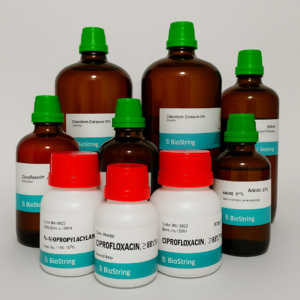
Chloramphenicol, Suitable For Plant Cell Culture
CAS NO: 56-75-7
| SKU Code | LBCHM-CB052 |
| Mol. Formula | Cl2CHCONHCH(CH2OH)CH(OH)C6H4NO2 |
| Mol. Weight | 323.13 |
| Size | 5 GM | 25 GM | 100 GM |
| Price | POR |
| Brand | Link Biotech |
Additional information
| Cas-no | 56-75-7 |
|---|---|
| Grade | Cell Biology |
| Brand | Link Biotech |
Chloramphenicol is an antibiotic useful for the treatment of a number of bacterial infections. This includes as an eye ointment to treat conjunctivitis. By mouth or by injection into a vein it is used to treat meningitis, plague, cholera, and typhoid fever. Its use by mouth or by injection is only recommended when safer antibiotics cannot be used and if used monitoring both blood levels of the medication and blood cell levels every two days is recommended during treatment
Chloramphenicol, suitable for plant cell culture – used for bacterial selection in molecular biology applications at 10-20 μg/mL and as a selection agent for transformed cells containing chloramphenicol resistance genes.
- Signal word Warning
- Hazard statements H351
- Precautionary statements P280
- RIDADR NONH for all modes of transport
- WGK Germany 3
- RTECS AB6825000