
| General Heparan sulfate ,HS elisa kit | |
| Method | Competitive |
| Samples | In serum, Plasma, tissue homogenates and Cell culture supernates and Other biological fluids. |
| Intended use | This immunoassay kit allows for the in vitro quantitative determination of General HS concentrations in serum, Plasma, tissue homogenates and Cell culture supernates and Other biological fluids. |

A-1/264A Paschim Vihar, New Delhi - 110063
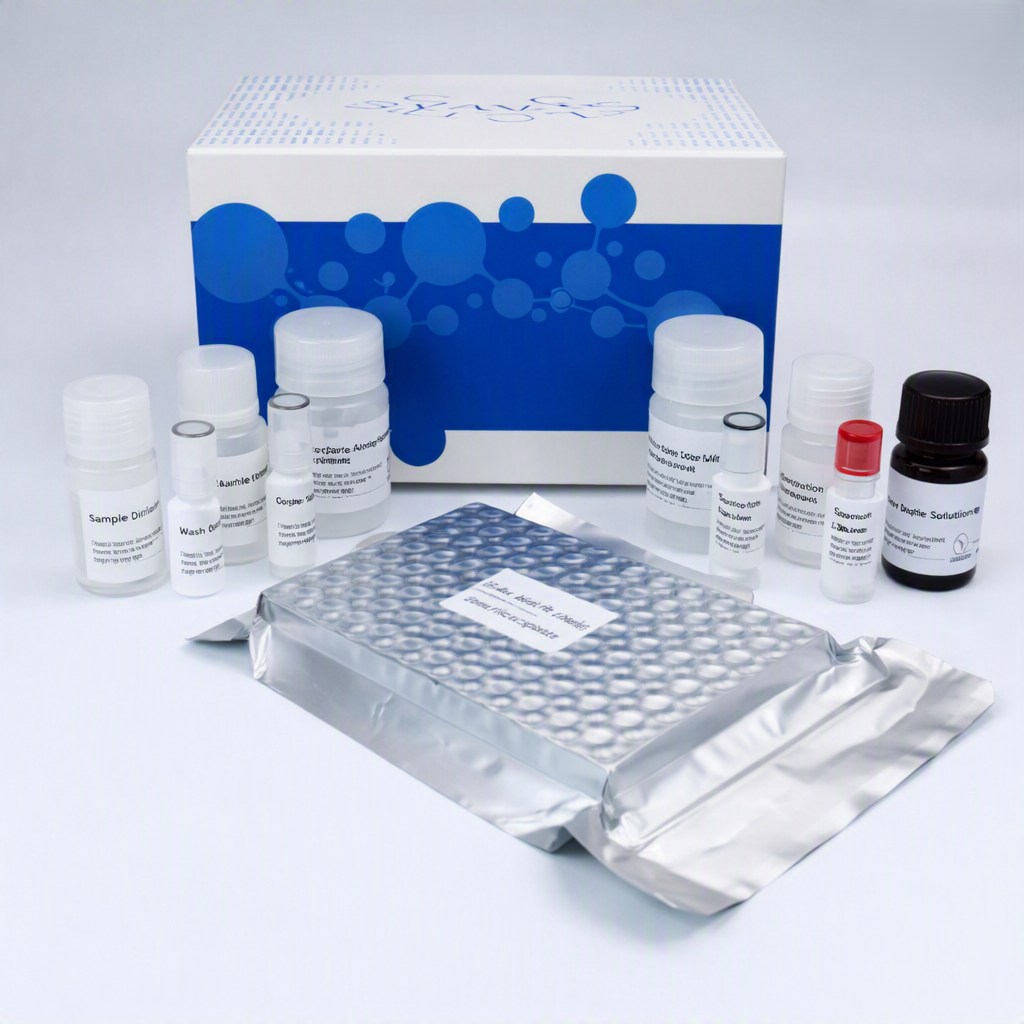
General Heparan sulfate ,HS elisa kit
| SKU Code | LBEK-0043G |
| Species | General |
| Sensitivity | 2.345ng/mL |
| Detection Range | 4.69-300 ng/mL |
| Size | 96 T | 48 T |
| Price | POR |
Additional information
| sensitivity | 2.345ng/mL |
|---|---|
| detection-range | 4.69-300 ng/mL |
| brand | Link Biotech |
The ELISA is based on the competitive binding enzyme immunoassay technique. The microtiter plate provided in this kit has been pre-coated with an antibody specific to General HS, During the reaction, General HS in the sample or standard competes with a fixed amount of biotin-labeled General HS for sites on a pre-coated Monoclonal antibody specific to General HS. Excess conjugate and unbound sample or standard are washed from the plate. Next, Avidin conjugated to Horseradish Peroxidase (HRP) is added to each microplate well and incubated. Then a TMB substrate solution is added to each well. The enzyme-substrate reaction is terminated by the addition of a sulphuric acid solution and the color change is measured spectrophotometrically at a wavelength of 450 nm ± 2 nm. The concentration of General HS in the samples is then determined by comparing the O.D. of the samples to the standard curve.
Precision
Intra-assay Precision (Precision within an assay):Three samples of known concentration were tested twenty times on one plate to assess intra-assay precision.
Intra-Assay CV: ≤3.8%
Inter-assay Precision (Precision between assays):Three samples of known concentration were tested in five separate assays to assess inter-assay precision.
Inter-Assay CV: ≤7.6%
Recovery
Recovery was determined by spiking various levels of Heparan sulfate into serum and plasma.
Recovery was determined by spiking various levels of Heparan sulfate into serum and plasma .
| Sample Type | Average(%) | Recovery Range (%) |
| Serum | 85 | 79-93 |
| Plasma | 92 | 85-101 |
Linearity
The linearity of the kit was assayed by testing samples spiked with appropriate concentration of Heparan sulfate and their serial dilutions. The results were demonstrated by the percentage of calculated concentration to the expected.
| Sample | 1:2 | 1:4 | 1:8 | 1:16 |
| serum(n=5) | 90-102% | 91-100% | 95-105% | 100-110% |
| EDTA plasma(n=5) | 93-105% | 102-114% | 107-117% | 104-113% |
| heparin plasma(n=5) | 91-101%
|
100-113% | 111-120% | 101-110% |
General Annotation
Function:
Heparan sulfate (HS) is a linear polysaccharide found in all animal tissues. It occurs as a proteoglycan (HSPG) in which two or three HS chains are attached in close proximity to cell surface or extracellular matrix proteins. It is in this form that HS binds to a variety of protein ligands and regulates a wide variety of biological activities, including developmental processes, angiogenesis, blood coagulation and tumour metastasis. HS has been shown to serve as cellular receptor for a number of viruses including the respiratory syncytial virus.